Rare eye colors include green, gray, amber, violet and red eyes
Some eye colors are easy to see at a glance. Others shift between two colors, change in different light, or have a warm inner ring, a violet shimmer, or an unusually pale red-toned look that changes the whole story.
Use our eye color rarity calculator to find out your unique eye color rarity score! Follow the chart, the compare eye color pages, and the heterochromia sections to find out more about rare eye colors.
Check your eye color rarity score
This score is for fun and educational use. Optional details like country, age, etc., only nudge the score gently and make the explanation feel more personal.
Choose an eye color path and keep exploring
Start with the eye color that feels closest, then use the eye color compare pages if your eyes change color depending on light, clothing, or distance.
Violet (also considered purple) eye color is one of the most searched rare eye colors
Violet eye color is rare, mysterious, and often confused with pale blue, gray, blue-gray, or red-toned eyes in unusual light. True violet-looking eyes are not usually treated as a common eye color category, which makes them especially interesting to compare.
Red eye color is rare, real, and often misunderstood
Red eye color is usually connected with very low iris pigment rather than a standard everyday eye color. Red-looking eyes may appear pink, pale red, red-violet, or very light depending on melanin, lighting, and eye structure.
Not sure what your eye color is?
A lot of people hover between green and hazel, blue and gray, or amber and warm brown. Start with the chart, then move into the eye color compare pages when you want a closer look.
A rarity score with room for nuance
The score is easy to understand without pretending to know everything. Lighting, mixed tones, central rings, and uncertainty all matter, so the result comes with a confidence level instead of a fake promise of perfect precision.
Keep going when one answer leads to another
Maybe you started here to ask whether green eyes are rare. Maybe you are trying to decide whether your eyes are hazel or amber. Either way, the next pages can help you keep exploring without getting lost.
Rarity is more than a single percentage
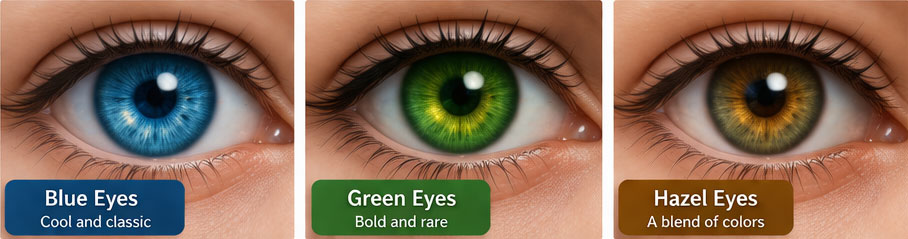
Some eye colors are rare worldwide. Others only feel rare because they are hard to photograph, easy to mislabel, or uncommon where you live. The score works best when color, pattern, and context all stay in the picture together.
Warm amber eyes, soft gray eyes, and unusual heterochromia patterns all create curiosity for different reasons. The best way to understand them is to look at color, undertone, and pattern together.
Different light can tell a different story
Many people only start searching because their eyes seem to shift. Blue can look gray. Hazel can look green. Amber can lean brown indoors. That does not mean you are imagining it. It just means eye color is more subtle than a label on a form.
Natural light, a relaxed first impression, and side-by-side comparisons are usually the fastest way to land on the right answer.
Try the rare eye color calculator, and see your fun eye color rarity score!
The quickest answer is not always the best answer. Start with the rare eye color calculator, then follow whatever direction feels most like your eyes. That is where the real fun begins.